Predict attention
before you launch.
Eye-tracking-style heatmaps, focus & clarity scores and area-of-interest analysis for ads, landing pages, video and creatives — in seconds, with no users.
per image — a website capture can take up to a minute
outputs: heatmap, focus, AOI & scanpath
point focus & clarity scoring
test participants required
See it through your audience's eyes — first.
Stop guessing
You can't un-launch a weak ad. See what gets noticed while you can still change it.
No test panels
Skip the cost and weeks of traditional eye-tracking. Get an answer in seconds.
Decide with data
Compare variants and rank a whole set by predicted focus — not opinion.
Everything you need to ship creative with confidence.
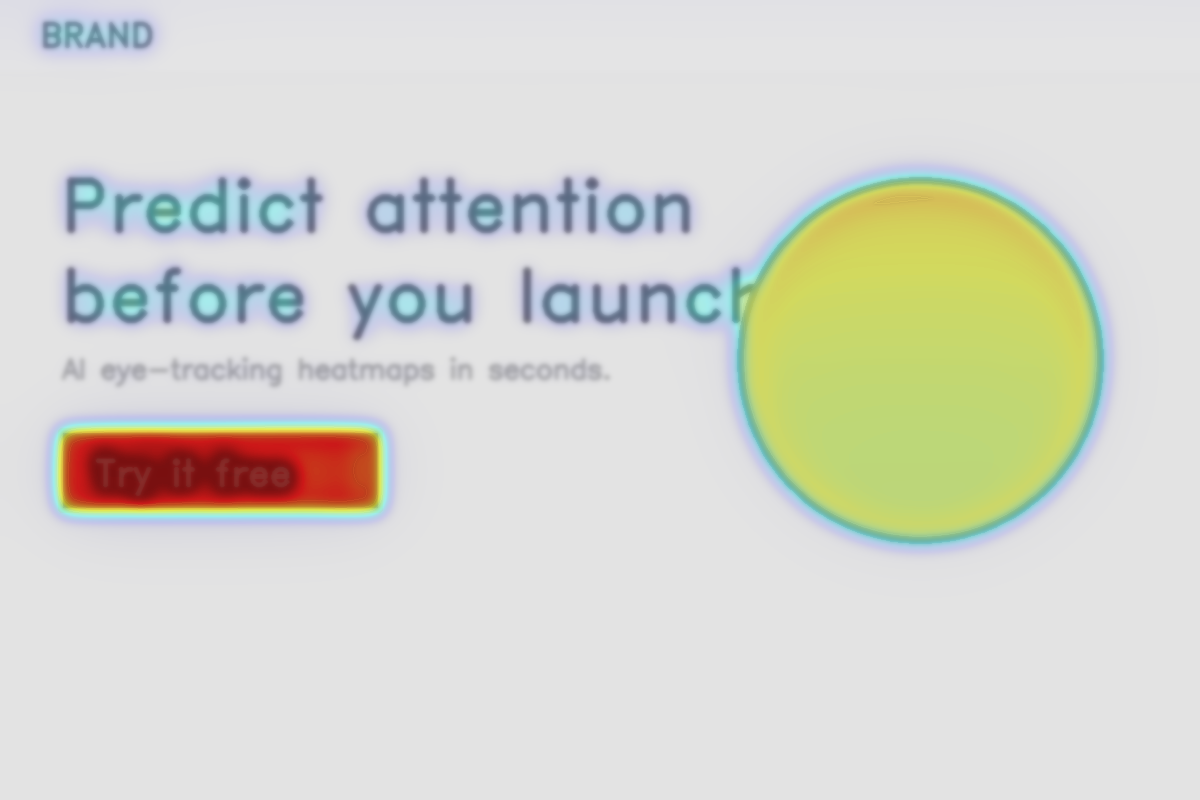
See exactly where eyes go first
- ✓Predicts the first seconds of attention — where decisions happen.
- ✓Instantly see whether your hero and CTA actually get noticed.
- ✓Works on ads, landing pages, emails, packaging — any creative.
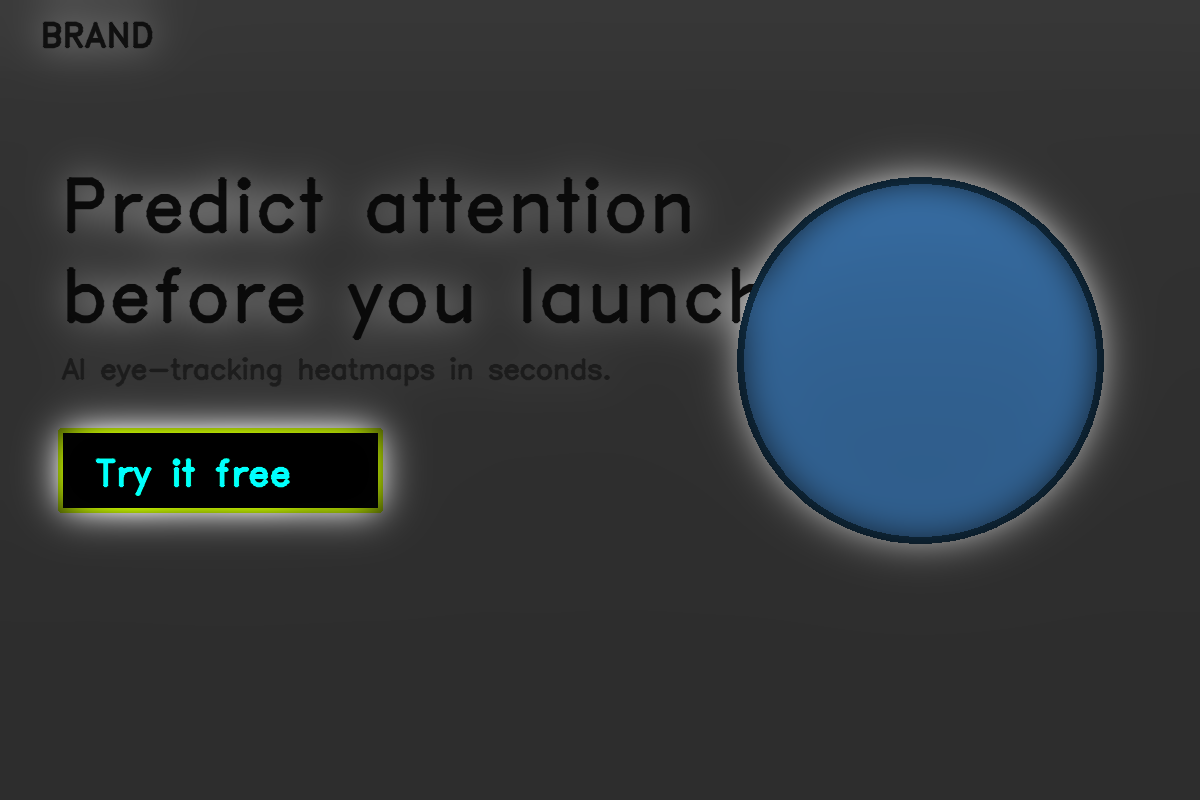
Score every creative 0–100
- ✓Focus = how concentrated attention is on a clear focal point.
- ✓Clarity = how clean and readable the visual hierarchy is.
- ✓Plain-English verdicts — Strong focus, Cluttered, and more.
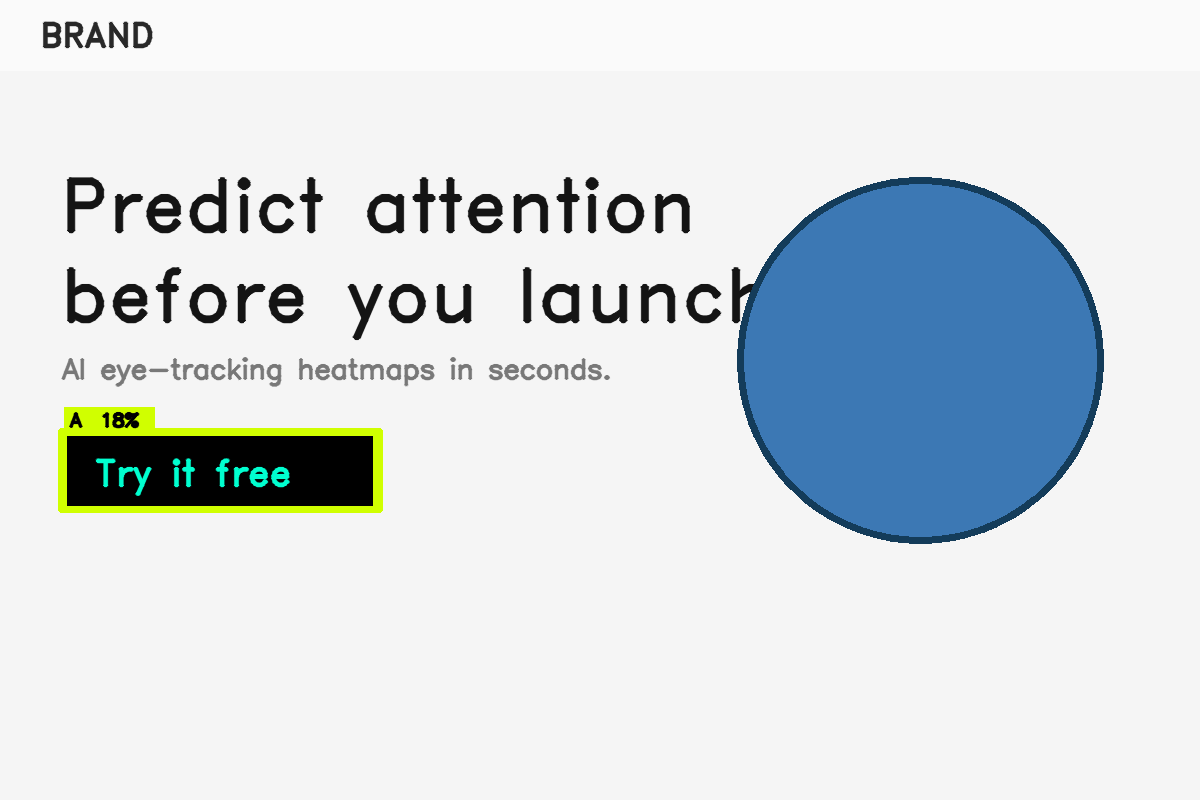
Know what % of attention each element earns
- ✓Auto-detects faces, headlines, CTAs and UI blocks — then AI names each one (logo, price, product photo…).
- ✓Reports the share of total attention each element captures.
- ✓Or draw your own regions to measure anything.
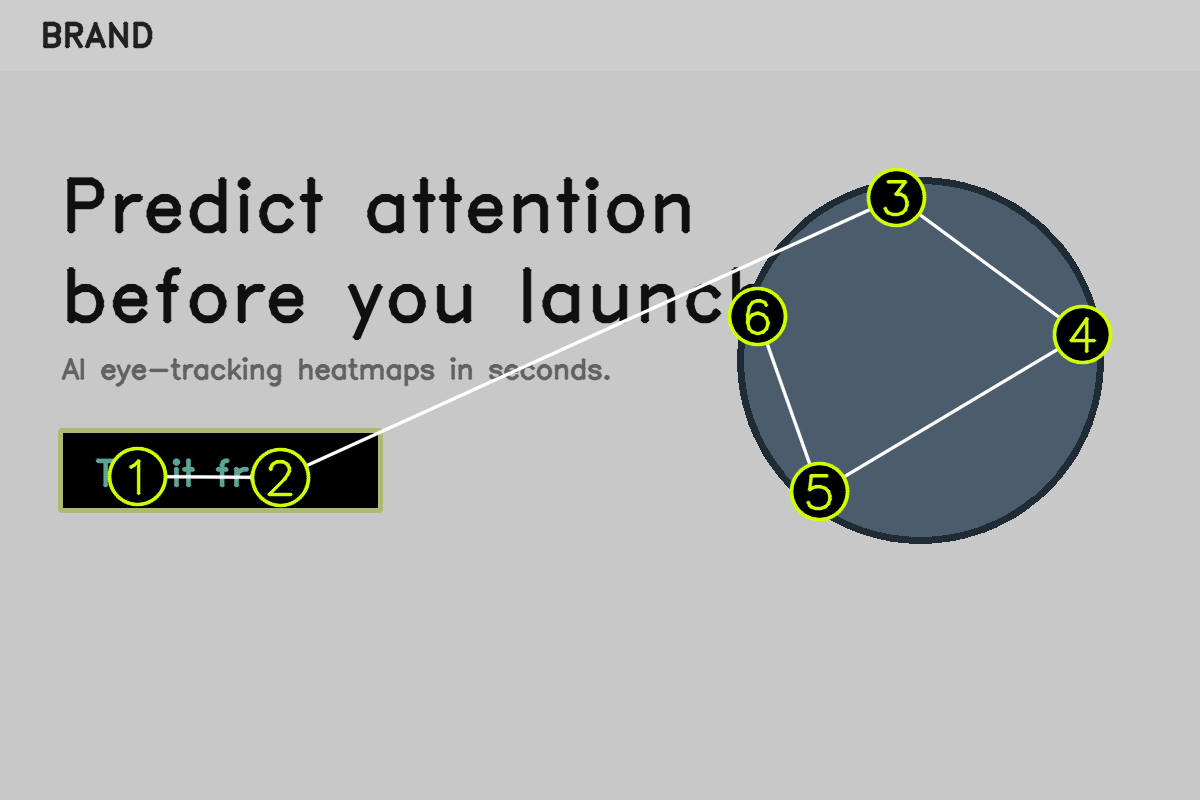
Follow the predicted path of attention
- ✓The 1 → 2 → 3 order the eye is likely to travel.
- ✓See if attention ever reaches your call-to-action — and when.
- ✓Catch dead-ends, detours and competing focal points.
Built for every creative you ship.
Paid ads & social
Pick the creative that earns attention before you spend.
Landing pages
Make sure the hero, value prop and CTA get seen.
Email & newsletters
Check the fold and the click before you send.
Packaging & print
See what stands out on a shelf or a page.
UX / UI design
Validate hierarchy and flow without a user test.
Video & reels
See how attention shifts over time, across frames sampled from the video.
Wherever your creative lives.
Web app
Upload an image or paste a page's URL — nothing to install.
Figma plugin
Analyze a frame in-context without leaving Figma.
Chrome extension
One click to heatmap the page you're looking at.
Three steps, under a minute.
Upload or paste a URL
An ad, a landing page, a video, or any creative.
Predict in seconds
Heatmap, focus & clarity, AOIs and scanpath.
Act before launch
Fix weak spots, compare variants, share with clients.
Built by VALUE.
Glanzz is made by VALUE, a digital marketing agency. We built it to pressure-test our own clients' ads, landing pages and packaging before launch, and now share it with the teams we work with, by invitation. Its attention model is trained on lab eye-tracking — the UEyes study, 62 people viewing 1,980 websites, apps and posters — and tested on screens it has never seen. How we test it →
Made by people who run campaigns for a living — so it answers what you ask before a launch: what gets seen, in what order, and what to fix.
We use Glanzz every day on live client work — ads, websites, emails and packaging across industries.
Want more than the tool? VALUE can take it further — the analysis, the redesign and the campaign, end-to-end.
Frequently asked.
Is this real eye-tracking?+
No — it's an AI prediction of visual attention. It estimates where people are likely to look, instantly and before launch, without recruiting users or hardware.
How accurate is it?+
It reliably surfaces the broad attention pattern — hero, headline, CTA and focal points. Treat the scores as directional: ideal for comparing variants and catching problems early.
What can I analyze?+
Any image — ads, landing pages, emails, packaging, app screens — a live website URL we capture for you, or a video ad.
Do I need to install anything?+
No. It runs in your browser. Optional Figma plugin and Chrome extension are available if you want it where you work.
See your next launch through your audience's eyes
Run your first attention analysis in under a minute.